Abstract
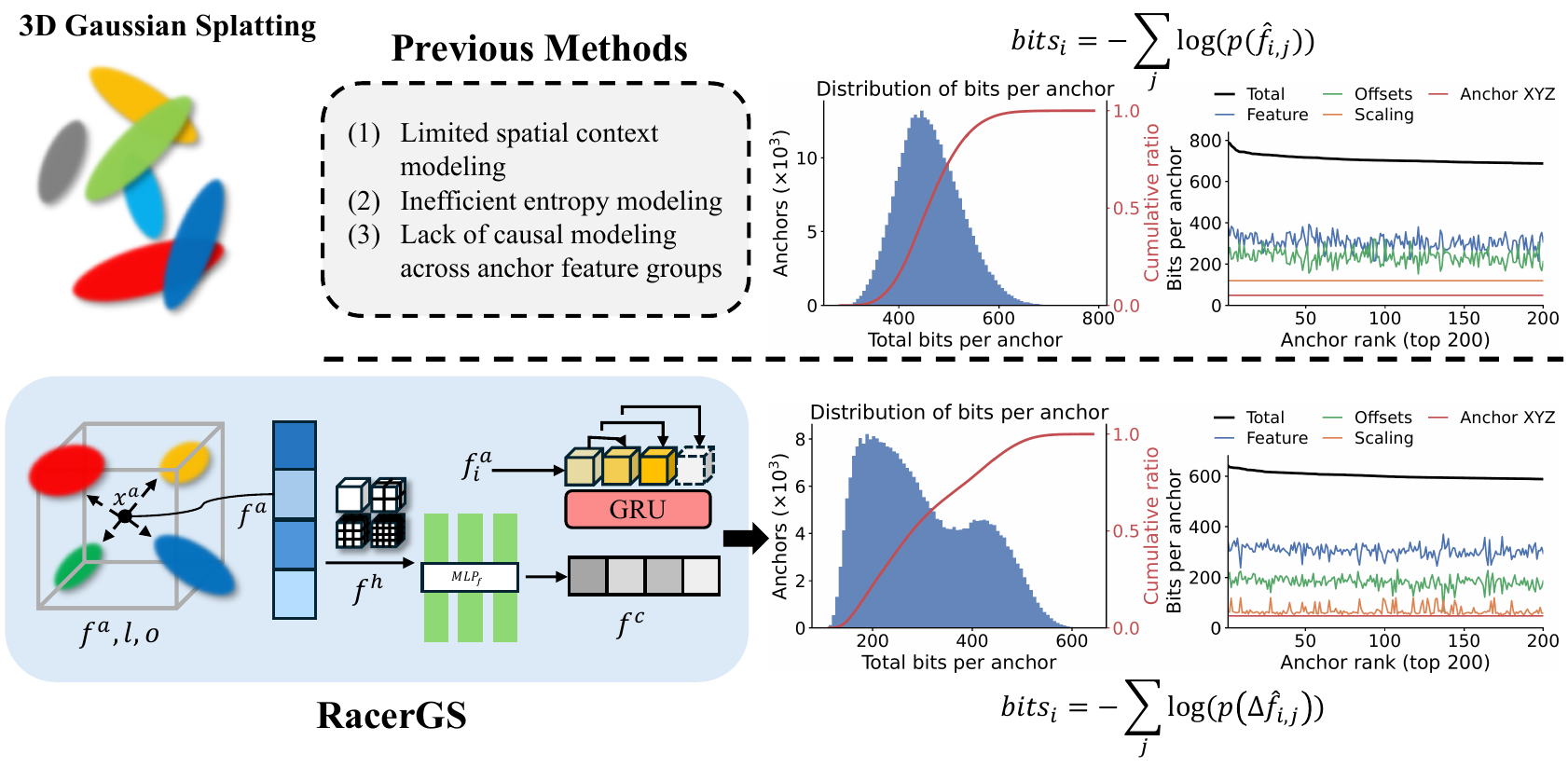
3D Gaussian Splatting (3DGS) has emerged as a promising approach for fast, high-quality novel-view rendering. However, its large parameter size remains a bottleneck for storage and transmission. We propose RacerGS, a compact 3DGS compression framework that achieves scene reconstruction at significantly reduced storage sizes with preserved fidelity. To obtain compact and spatially coherent features, we design a hash projection model that projects the anchor hash encodings into compact context features. Additionally, we introduce a FiLM-modulated autoregressive GRU context model that utilizes causal dependencies among anchor feature groups and uses recurrent hidden states to refine entropy-model parameters, improving bitrate efficiency. Furthermore, we adaptively entropy-code quantized anchor-attribute residuals relative to their context-predicted means, leveraging spatial consistency to reduce symbol entropy.
Overall, RacerGS achieves more than 150× compression over vanilla 3DGS and 28× over Scaffold-GS, while providing comparable rendering quality. Extensive experiments across five datasets demonstrate that RacerGS outperforms prior 3DGS compression methods in both storage reduction and rate-distortion performance.
Method
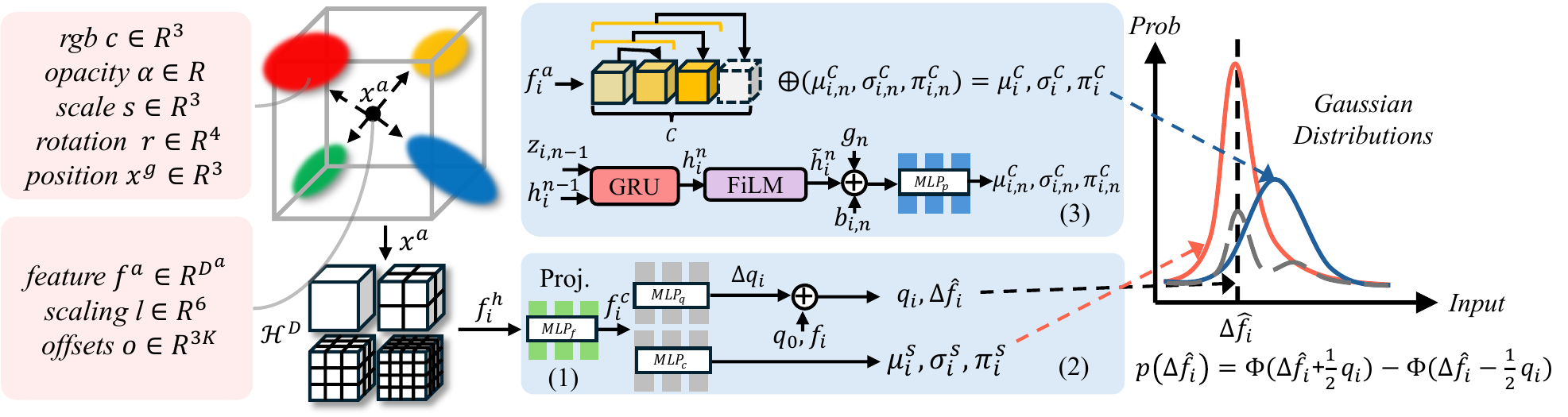
RacerGS builds on an anchor-based 3DGS codec and compresses each anchor's feature fa, scaling l, and offsets o with three components. The refined entropy parameters are combined with the spatial prior to form a Gaussian mixture model for residual entropy coding.
(1) Hash projection model
Instead of feeding raw multi-resolution hash encodings fh to the entropy networks, an MLP projects them into compact, fused context features fc, so the entropy context stays low-dimensional while the hash grid keeps its capacity.
(2) Adaptive residual quantization
Anchor attributes are quantized and entropy-coded as residuals around their context-predicted means with learned step sizes, r = ⌊(f − μs) ⊘ q⌉, which contracts the dynamic range and lowers symbol entropy.
(3) FiLM-modulated autoregressive GRU
Each anchor feature is split into chunks. A GRU advances one step per decoded chunk, its hidden state is FiLM-modulated, and a weight-shared, chunk-positional predictor refines the entropy parameters of the next chunk.
Qualitative Comparisons
Zoomed-in crops with PSNR / size per method. RacerGS preserves edges and material details at a fraction of the storage.

garden (Mip-NeRF360): fewer leaf artifacts

playroom (DeepBlending): clearer book titles

train (Tanks&Temples): sharper metal structures

lego (Synthetic-NeRF)

quebec (BungeeNeRF)
Rate-Distortion Results
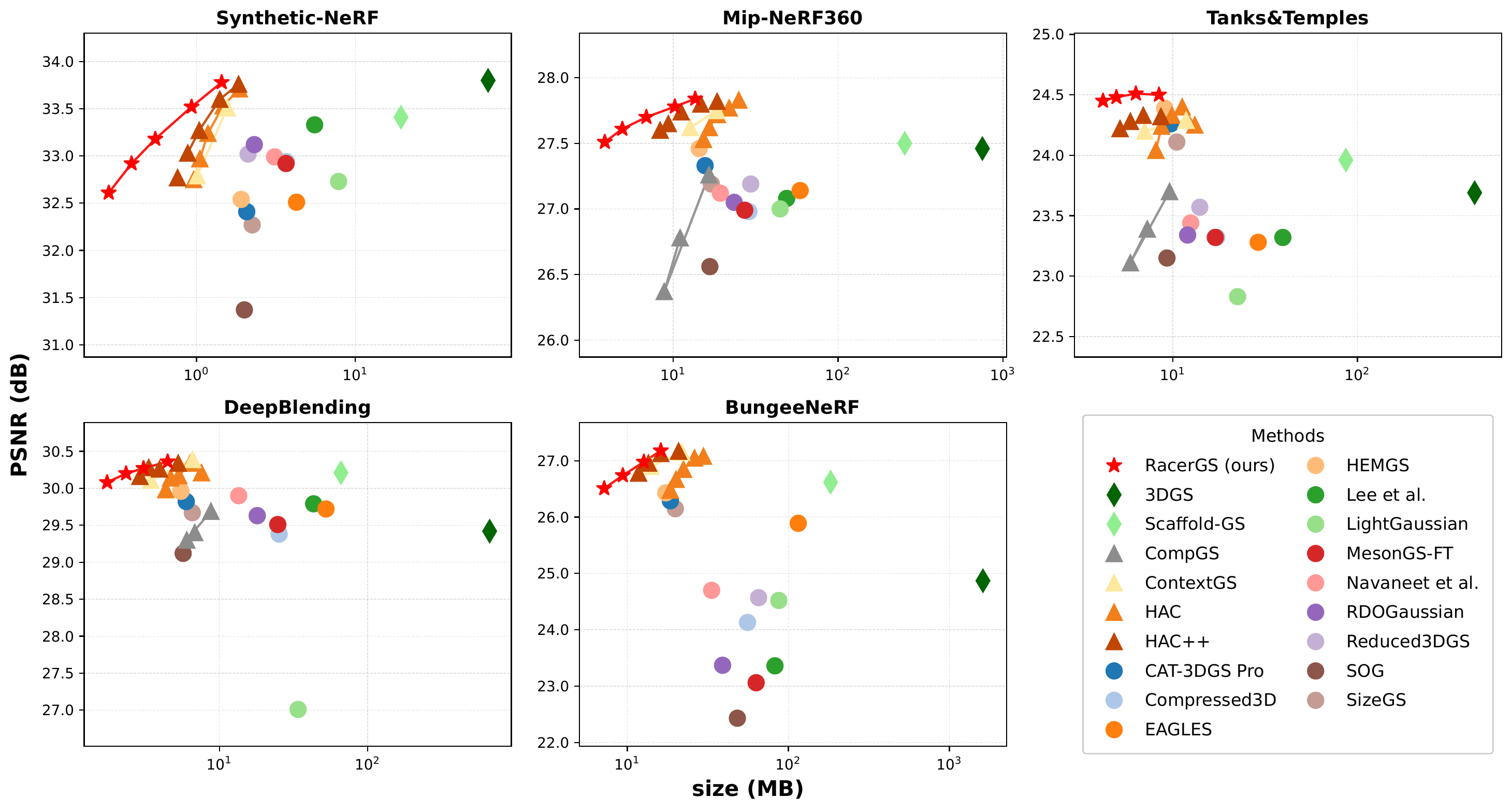
RD curves on Synthetic-NeRF, Mip-NeRF360, Tanks&Temples, DeepBlending, and BungeeNeRF. RacerGS reaches a better rate-distortion trade-off than codebook, pruning, entropy, and anchor-based baselines across datasets.
Quantitative Comparisons
Storage sizes in MB. The best and second-best compression results are highlighted in green and blue; lr / hr denote the low- and high-rate settings.
| Method | Synthetic-NeRF | Mip-NeRF360 | Tanks&Temples | |||||||||
|---|---|---|---|---|---|---|---|---|---|---|---|---|
| PSNR↑ | SSIM↑ | LPIPS↓ | Size↓ | PSNR↑ | SSIM↑ | LPIPS↓ | Size↓ | PSNR↑ | SSIM↑ | LPIPS↓ | Size↓ | |
| 3DGS | 33.80 | 0.970 | 0.031 | 68.46 | 27.46 | 0.812 | 0.222 | 750.9 | 23.69 | 0.844 | 0.178 | 431.0 |
| Scaffold-GS | 33.41 | 0.966 | 0.035 | 19.36 | 27.50 | 0.806 | 0.252 | 253.9 | 23.96 | 0.853 | 0.177 | 86.50 |
| Lee et al. | 33.33 | 0.968 | 0.034 | 5.54 | 27.08 | 0.798 | 0.247 | 48.80 | 23.32 | 0.831 | 0.201 | 39.43 |
| Compressed3D | 32.94 | 0.967 | 0.033 | 3.68 | 26.98 | 0.801 | 0.238 | 28.80 | 23.32 | 0.832 | 0.194 | 17.28 |
| EAGLES | 32.51 | 0.964 | 0.039 | 4.26 | 27.14 | 0.809 | 0.231 | 58.91 | 23.28 | 0.835 | 0.203 | 28.99 |
| SizeGS | 32.27 | 0.956 | 0.043 | 2.24 | 27.19 | 0.788 | 0.253 | 17.05 | 24.11 | 0.833 | 0.191 | 10.51 |
| LightGaussian | 32.73 | 0.965 | 0.037 | 7.84 | 27.00 | 0.799 | 0.249 | 44.54 | 22.83 | 0.822 | 0.242 | 22.43 |
| SOG | 31.37 | 0.959 | 0.043 | 2.00 | 26.56 | 0.791 | 0.241 | 16.70 | 23.15 | 0.828 | 0.198 | 9.30 |
| Navaneet et al. | 32.99 | 0.966 | 0.037 | 3.10 | 27.12 | 0.806 | 0.240 | 19.33 | 23.44 | 0.838 | 0.198 | 12.50 |
| Reduced3DGS | 33.02 | 0.967 | 0.035 | 2.11 | 27.19 | 0.807 | 0.230 | 29.54 | 23.57 | 0.840 | 0.188 | 14.00 |
| CAT-3DGS Pro | 32.41 | 0.959 | 0.041 | 2.07 | 27.33 | 0.793 | 0.245 | 15.62 | 24.26 | 0.838 | 0.188 | 9.74 |
| RDOGaussian | 33.12 | 0.967 | 0.035 | 2.31 | 27.05 | 0.802 | 0.239 | 23.46 | 23.34 | 0.835 | 0.195 | 12.03 |
| HEMGS | 32.54 | 0.962 | 0.038 | 1.91 | 27.46 | 0.797 | 0.241 | 14.38 | 24.39 | 0.842 | 0.185 | 9.03 |
| MesonGS-FT | 32.92 | 0.968 | 0.033 | 3.66 | 26.99 | 0.796 | 0.247 | 27.16 | 23.32 | 0.837 | 0.193 | 16.99 |
| HAC (lr) | 33.24 | 0.967 | 0.037 | 1.18 | 27.53 | 0.807 | 0.238 | 15.26 | 24.04 | 0.846 | 0.187 | 8.10 |
| HAC (hr) | 33.71 | 0.968 | 0.034 | 1.86 | 27.77 | 0.811 | 0.230 | 21.87 | 24.40 | 0.853 | 0.177 | 11.24 |
| ContextGS (lr) | 32.79 | 0.965 | 0.040 | 1.01 | 27.62 | 0.808 | 0.237 | 12.68 | 24.20 | 0.852 | 0.184 | 7.05 |
| ContextGS (hr) | 33.51 | 0.968 | 0.035 | 1.56 | 27.75 | 0.811 | 0.231 | 18.41 | 24.29 | 0.855 | 0.176 | 11.80 |
| CompGS (lr) | - | - | - | - | 26.37 | 0.778 | 0.267 | 8.83 | 23.11 | 0.815 | 0.236 | 5.89 |
| CompGS (hr) | - | - | - | - | 27.26 | 0.803 | 0.239 | 16.50 | 23.70 | 0.837 | 0.208 | 9.60 |
| HAC++ (lr) | 33.03 | 0.966 | 0.039 | 0.88 | 27.60 | 0.803 | 0.253 | 8.34 | 24.22 | 0.849 | 0.190 | 5.18 |
| HAC++ (hr) | 33.76 | 0.969 | 0.033 | 1.84 | 27.82 | 0.811 | 0.231 | 18.48 | 24.32 | 0.854 | 0.178 | 8.63 |
| RacerGS (lr) | 32.61 | 0.964 | 0.041 | 0.28 | 27.51 | 0.801 | 0.262 | 3.85 | 24.45 | 0.847 | 0.195 | 4.19 |
| RacerGS (hr) | 33.78 | 0.970 | 0.035 | 1.44 | 27.84 | 0.811 | 0.243 | 13.61 | 24.50 | 0.855 | 0.183 | 8.42 |
Swipe to see all columns →
| Method | DeepBlending | BungeeNeRF | ||||||
|---|---|---|---|---|---|---|---|---|
| PSNR↑ | SSIM↑ | LPIPS↓ | Size↓ | PSNR↑ | SSIM↑ | LPIPS↓ | Size↓ | |
| 3DGS | 29.42 | 0.899 | 0.247 | 663.9 | 24.87 | 0.841 | 0.205 | 1616 |
| Scaffold-GS | 30.21 | 0.906 | 0.254 | 66.00 | 26.62 | 0.865 | 0.241 | 183.0 |
| Lee et al. | 29.79 | 0.901 | 0.258 | 43.21 | 23.36 | 0.788 | 0.251 | 82.60 |
| Compressed3D | 29.38 | 0.898 | 0.253 | 25.30 | 24.13 | 0.802 | 0.245 | 55.79 |
| EAGLES | 29.72 | 0.906 | 0.249 | 52.34 | 25.89 | 0.865 | 0.197 | 115.2 |
| SizeGS | 29.67 | 0.898 | 0.257 | 6.57 | 26.15 | 0.831 | 0.251 | 19.88 |
| LightGaussian | 27.01 | 0.872 | 0.308 | 33.94 | 24.52 | 0.825 | 0.255 | 87.28 |
| SOG | 29.12 | 0.892 | 0.270 | 5.70 | 22.43 | 0.708 | 0.339 | 48.25 |
| Navaneet et al. | 29.90 | 0.907 | 0.251 | 13.50 | 24.70 | 0.815 | 0.266 | 33.39 |
| Reduced3DGS | 29.63 | 0.902 | 0.249 | 18.00 | 24.57 | 0.812 | 0.228 | 65.39 |
| CAT-3DGS Pro | 29.82 | 0.901 | 0.255 | 5.98 | 26.29 | 0.836 | 0.248 | 18.52 |
| RDOGaussian | 29.63 | 0.902 | 0.252 | 18.00 | 23.37 | 0.762 | 0.286 | 39.06 |
| HEMGS | 29.96 | 0.904 | 0.253 | 5.51 | 26.43 | 0.840 | 0.241 | 17.34 |
| MesonGS-FT | 29.51 | 0.901 | 0.251 | 24.76 | 23.06 | 0.771 | 0.235 | 63.11 |
| HAC (lr) | 29.98 | 0.902 | 0.269 | 4.35 | 26.48 | 0.845 | 0.250 | 18.49 |
| HAC (hr) | 30.34 | 0.906 | 0.258 | 6.35 | 27.08 | 0.872 | 0.209 | 29.72 |
| ContextGS (lr) | 30.11 | 0.907 | 0.265 | 3.45 | 26.90 | 0.866 | 0.222 | 14.00 |
| ContextGS (hr) | 30.39 | 0.909 | 0.258 | 6.60 | 27.15 | 0.875 | 0.205 | 21.80 |
| CompGS (lr) | 29.30 | 0.895 | 0.293 | 6.03 | - | - | - | - |
| CompGS (hr) | 29.69 | 0.901 | 0.269 | 8.77 | - | - | - | - |
| HAC++ (lr) | 30.16 | 0.907 | 0.256 | 2.91 | 26.78 | 0.858 | 0.235 | 11.75 |
| HAC++ (hr) | 30.34 | 0.911 | 0.254 | 5.28 | 27.17 | 0.879 | 0.196 | 20.82 |
| RacerGS (lr) | 30.08 | 0.906 | 0.271 | 1.75 | 26.51 | 0.845 | 0.255 | 7.19 |
| RacerGS (hr) | 30.36 | 0.913 | 0.256 | 4.48 | 27.18 | 0.867 | 0.216 | 16.15 |
Swipe to see all columns →
RacerGS outperforms the baselines in size reduction and fidelity preservation across diverse datasets.
BibTeX
@inproceedings{wang2026racergs,
  title={RacerGS: Residual-Autoregressive Context for 3D Gaussian Splatting Compression},
  author={Wang, Wenqing and Zeng, Huimin and Fu, Yun},
  booktitle={Advances in Neural Information Processing Systems},
  year={2026},
  eprint={2610.34263},
  archivePrefix={arXiv},
  primaryClass={cs.CV}
}